
Spectrum and Digital Connectivity: Making Better Use of an Invisible Resource

When people talk about internet connectivity, they usually think about cell towers, fiber cables, smartphones, Wi-Fi routers, and satellites.
But behind many of these technologies is something invisible and very important: spectrum.
Spectrum is the range of radio frequencies used to send information wirelessly.
It allows mobile phones, Wi-Fi devices, radios, satellites, and base stations to communicate without physical wires.

A simple way to understand a spectrum is to imagine it as an invisible road in the air.
Messages, video calls, online classes, payment transactions, emergency alerts, and many other digital services move through this invisible road.
But like a normal road, the spectrum has limits.
It is not unlimited.
That is why the spectrum must be planned, managed, and used efficiently.

Why Spectrum and Digital Connectivity Matter
At the center of the spectrum and digital connectivity is a simple idea: wireless services need invisible frequency resources to move information from one device to another.
Spectrum is used by many important services, including:
Mobile networks
Wi-Fi
Radio and television broadcasting
Satellite communication
Aviation
Maritime communication
Emergency services
Public safety systems
Industrial and private networks
Because many sectors depend on spectrum, it is treated as a carefully managed national resource.
For mobile connectivity, spectrum is usually assigned to licensed operators and authorized users.
They use it to provide services such as 4G, 5G, fixed wireless access, voice calls, mobile broadband, and other wireless services.
But assigning spectrum is only one part of the challenge.
The bigger question is:
How do we make sure spectrum creates the most value for people, businesses, communities, and the country?

Spectrum Is Scarce, So It Should Be Maximized
Spectrum is valuable because only a limited amount is available for each service type.
If the spectrum is not used efficiently, connectivity can suffer.
Users may experience:
Weak signal
Slow mobile data
Limited coverage
Congested networks
Higher cost of deployment
Poor service in difficult-to-reach areas
This is especially important in rural, island, mountainous, and low-density communities.
In many of these locations, the need for connectivity is real.
Schools need the internet.
Health centers need access to digital systems.
Local businesses need online services.
Farmers, students, workers, and families need reliable communication.
However, deploying networks in these areas can be difficult.
The cost of building and operating infrastructure may be high, while the expected commercial return may be low.
This is not a simple problem.
Operators must consider business sustainability.
The government must consider public access.
Communities need usable services.
Technology providers need practical deployment models.
This is why efficient spectrum use requires cooperation.

The Business Case Challenge
In high-density areas, network deployment is easier to justify.
There are more users, more traffic, and more potential revenue.
In remote or low-density areas, the situation is different.
A provider may need to spend on:
Towers or poles
Power systems
Fiber or microwave backhaul
Site acquisition
Permits
Transport
Security
Maintenance
Field support
When the number of users is small, recovering those costs becomes difficult.
This is one reason why some areas may not immediately receive the same level of connectivity as cities and commercial centers.
The issue is not always a lack of interest.
Often, the issue is economics.
The challenge is how to make deployment more practical when the business case is weak.

The Risk of Underutilized Spectrum
When the spectrum is assigned but not fully used in certain locations, its full value is not realized.
This does not mean the spectrum holder is doing something wrong.
It may simply mean that deployment in that area is too costly, too complex, or not yet commercially viable.
But from a national connectivity perspective, underutilized spectrum is still an opportunity.
If there are communities that need connectivity and frequency resources are not actively used in those locations, then it is worth exploring practical ways to make that spectrum useful.
The goal should be simple:
Make spectrum serve more people, without creating harmful interference, unfair burden, or unsustainable business pressure.
How Spectrum Can Be Used More Efficiently
There is no single solution.
Efficient spectrum use requires a mix of policy, engineering, business models, and local collaboration.
Here are several practical approaches.
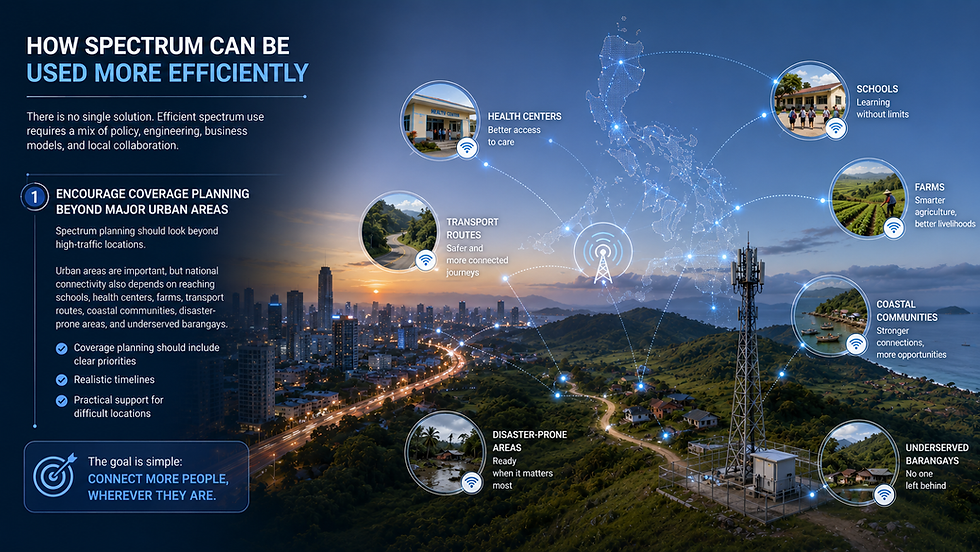
1. Encourage Coverage Planning Beyond Major Urban Areas
Spectrum planning should look beyond high-traffic locations.
Urban areas are important, but national connectivity also depends on reaching schools, health centers, farms, transport routes, coastal communities, disaster-prone areas, and underserved barangays.
This does not mean every area can be served immediately.
But it does mean coverage planning should include clear priorities, realistic timelines, and practical support for difficult locations.

2. Support Infrastructure Sharing
One of the biggest barriers to rural connectivity is cost.
If every provider needs to build a separate infrastructure, deployment becomes expensive and slow.
Infrastructure sharing can help reduce costs.
This may include sharing:
Towers
Poles
Power systems
Fiber backhaul
Microwave links
Equipment shelters
Site facilities
When infrastructure is shared properly, the business case can improve.
This can make deployment in less-profitable areas more feasible.

3. Explore Spectrum Sharing Where Appropriate
In some locations, the assigned spectrum may not be actively used at all times or across all areas.
With proper rules, coordination, and technical safeguards, spectrum sharing may help improve connectivity.
This does not mean open or uncontrolled use.
Spectrum sharing must be carefully managed to avoid interference and protect existing services.
Possible safeguards include:
Proper authorization
Defined geographic limits
Power limits
Non-interference requirements
Technical coordination
Monitoring and reporting
When done properly, spectrum sharing can help extend connectivity in areas where traditional deployment is difficult.

4. Enable Local and Complementary Connectivity Models
Large national networks are essential.
But they do not have to be the only model for connectivity.
In some underserved areas, complementary networks may help.
These may involve:
Local internet service providers
Cooperatives
Universities
Local government units
Community networks
Private networks for specific use cases
Public-private partnerships
These models should not be seen as competition against national operators.
They can be designed as complementary solutions, especially in areas where deployment is difficult under normal commercial conditions.
The key is proper coordination, licensing, technical compliance, and sustainability.

5. Use Public Support for Areas With Weak Commercial Return
Some areas may not be attractive based on commercial return alone.
But they may still be important for education, health, public safety, agriculture, tourism, disaster response, and local economic development.
For these areas, public support can help.
This may include:
Connectivity grants
Universal service programs
Tax incentives
Shared infrastructure projects
Subsidized backhaul
Public-private partnerships
Support for schools, health centers, and government facilities
The important point is that support should be tied to actual service outcomes.
The measure should not be limited to whether a project was launched.
The better measure is whether people can actually use the service.

6. Improve Spectrum Monitoring and Data
Good decisions need good data.
To improve spectrum use, stakeholders need better visibility into where spectrum is active, congested, or underutilized.
Spectrum monitoring can help answer practical questions such as:
Which frequencies are being used in a specific area?
Is there harmful interference?
Are networks congested?
Are there locations where the spectrum could be used more effectively?
Are users receiving the expected level of service?
This is where tools such as spectrum analyzers, field measurements, network data, and coverage validation become useful.
You cannot improve what you cannot measure.

A Balanced Way Forward
Spectrum is one of the foundations of digital connectivity.
But spectrum alone does not create connectivity.
It must be supported by infrastructure, investment, regulation, engineering, local coordination, and sustainable business models.
The challenge is to make spectrum useful not only where deployment is easy, but also where connectivity can create strong social and economic value.
This requires balance.
Operators need viable business conditions.
The government needs to protect the public interest.
Communities need reliable access.
Technology providers need practical deployment options.
Regulators need to prevent interference and ensure fair use.
No single group can solve the connectivity gap alone.

Final Thought
Spectrum is an invisible but limited resource.
When used well, it helps connect people, businesses, schools, health centers, government offices, and communities.
When not fully maximized, its value is reduced.
The goal should not be to blame any sector.
The goal should be to ask a better question:
How can we make Spectrum create more value for more people?
The answer will likely come from a combination of better planning, infrastructure sharing, practical spectrum sharing, local connectivity models, public support, and better measurement.
Digital connectivity is now part of modern life.
If the spectrum is one of the invisible roads that carries digital services, then we should keep finding better ways to make that road useful, reliable, and accessible to more communities.
Richard Matias

This is a good read. I was thinking of possible research topic and this helped me a lot!